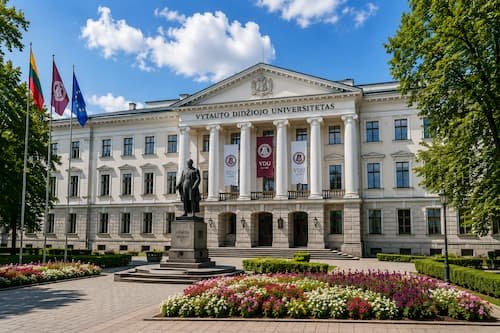
Are you planning to study abroad in Europe? In this article, we will share a complete guide to the Top Universities in Lithuania for international students
Top universities in Lithuania are getting a lot more attention lately, and honestly, it makes sense. You get genuinely solid academics, a system built on European standards, and tuition that won’t wreck your budget the way Western Europe often does. If you’ve been comparing study destinations and Lithuania keeps popping up, this guide should tell you everything you actually need to know before applying.
I’ll walk you through how the education system works, which universities are worth your attention, what they cost, and how the application process actually goes. No fluff — just what matters when you’re the one making the decision.
Quick Overview
- Lithuania offers strong higher education with real value for money, and international interest is growing fast.
- The five names worth knowing: Vilnius University, VILNIUS TECH, Kaunas University of Technology, Vytautas Magnus University, and Lithuanian University of Health Sciences.
- Each one stands out for something different — academic tradition, practical training, or a specific field like engineering or medicine.
- English-taught programs are widespread, especially at Master’s level.
- Applications are almost entirely online, and the process usually starts with getting your prior education recognized in Lithuania.
- Tuition and living costs sit noticeably below most of Western Europe.
Understanding Lithuania’s Higher Education System
Before comparing individual schools, it helps to understand how the system is structured. Lithuania has a mix of public universities, private universities, colleges, and specialized institutions — which means your options depend a lot on your budget, your field, and how research-focused you want your degree to be.
Some students want a university with deep academic tradition behind it. Others care more about a strong engineering department, a solid business program, or a school known specifically for health sciences. The good news is that Lithuania’s top universities cover most of that range between them, and nearly all of them now offer English-taught tracks and exchange programs for international students.
Why Choose Lithuania for Your Higher Education?
Lithuania sits at a genuinely useful crossroads — culturally and geographically between Eastern and Western Europe — and its universities reflect that mix of old academic tradition and modern, practically-oriented programs.
A few things make it an easy country to settle into as a student:
- English is widely spoken, which makes day-to-day life less of an adjustment than you might expect.
- Living costs are noticeably lower than Germany, the Netherlands, or the Nordic countries.
- Tuition at public universities starts at a genuinely affordable level for most Bachelor’s programs.
- English-taught programs are common, particularly at Master’s level.
If you’re weighing Lithuania against other Baltic or Central European options, our Study in the Baltics: Country Comparison Guide breaks down how it stacks up against Latvia, Estonia, and Poland.
How the System Is Structured
Lithuanian universities and colleges are accredited under the Bologna Process, so degrees follow the standard three-cycle structure: Bachelor’s, Master’s, and Doctorate. That matters because it means your degree is recognized across the EU without extra hoops to jump through.
Public universities tend to be larger and more research-driven, while private institutions often specialize in a narrower set of professional fields. Neither is objectively “better” — it really depends on what you’re after.
What Makes Lithuanian Universities Worth Considering
A few things consistently stand out across the country’s top universities:
- A genuinely wide spread of programs — engineering, law, medicine, business, social sciences, and humanities are all well represented.
- Degrees structured through the European Credit Transfer System (ECTS), so credits transfer cleanly if you study elsewhere in Europe later.
- A strong emphasis on practical experience through programs like Erasmus, IAESTE, and AIESEC, alongside direct workplace placements.
- Active, visible international student communities — you’re rarely the only foreign student in the room.
International Recognition and Rankings
None of Lithuania’s universities crack the global top 200, and it’s worth being upfront about that. But several of them do appear in respected global rankings, and the trajectory is clearly upward. Vilnius University is the strongest performer, followed by Kaunas University of Technology and Vytautas Magnus University.
| University | National Rank | Global Rank |
|---|---|---|
| Vilnius University | #1 | #651 |
| Kaunas University of Technology | #2 | #1080 |
| Vytautas Magnus University | #3 | #1415 |
| Vilnius Gediminas Technical University | #4 | #1536 |
| Lithuanian University of Health Sciences | #5 | #2170 |
(Rankings based on Times Higher Education / QS global rankings — figures can shift year to year, so check current data before finalizing your choice.)
What matters more than the raw number, though, is that all of these institutions issue Bologna-compliant degrees. That means the qualification travels — employers and universities across the EU recognize it without extra verification steps.
The Top 5 Universities in Lithuania
1. Vilnius University
Founded in 1579, Vilnius University is both the oldest and the highest-ranked university in the country. If academic tradition matters to you, this is the name that carries the most weight in Lithuania.
It offers an unusually wide range of programs across humanities, sciences, and technology, at every academic level. That breadth makes it a solid choice if you’re not 100% locked into one field yet.
- Location: Right in the heart of Vilnius, the capital.
- Reputation: Historic roots combined with real modern relevance internationally.
- Best for: Students who want a lively city, a strong academic environment, and flexibility across fields.
2. Kaunas University of Technology (KTU)
Founded in 1922, KTU ranks second nationally and is one of the country’s leading research institutions. Its reputation is built primarily on engineering and applied technology programs that stay closely connected to industry needs.
It’s not purely technical, though — KTU also runs solid social sciences programs, so you’re not locked into a narrow track if your interests shift. It’s also Lithuania’s representative for IAESTE, which says a lot about how seriously it takes career-focused, practical training.
3. Vytautas Magnus University (VMU)
Also founded in 1922, VMU ranks third and covers a genuinely broad spectrum — humanities, natural sciences, and social sciences all have a real presence here. If you want flexibility rather than a narrowly specialized program, this is worth a close look.
It’s particularly strong for students interested in subjects that sit at the intersection of culture, society, and policy. The available records don’t list specific notable alumni, but the university’s long history and national standing speak for themselves.
4. Vilnius Gediminas Technical University (VILNIUS TECH)
Founded in 1956, VILNIUS TECH ranks fourth nationally and is best known for engineering, architecture, and technical sciences. It also has a meaningful presence in business management, which makes it a decent fit if you want technical training paired with management skills.
English-taught programs are common here too, especially at graduate level, which is a big part of why it continues to attract international applicants.
5. Lithuanian University of Health Sciences (LSMU)
Founded in 1922 and based in Kaunas, LSMU ranks fifth and is the country’s leading specialist institution for anything medicine-related — medicine itself, pharmacy, veterinary sciences, and other health fields, across all academic levels.
If you already know healthcare is your path, the specialist focus here actually simplifies things. You’re not choosing electives from a huge general catalogue; the whole environment is built around your field.
What Does It Cost?
Tuition varies by institution and program, but here’s a rough range to work with:
- Bachelor’s degrees at public universities: roughly EUR 1,000–5,300 per year
- Master’s degrees: roughly EUR 2,200–6,500 per year
These numbers move depending on the program and university, so treat them as a starting point for budgeting rather than a fixed number. For a full cost-of-living breakdown alongside tuition, see our Cost of Studying in Lithuania guide.
How to Apply to Lithuania’s Top Universities
Applying is fairly straightforward once you know your target program, but international students should start earlier than they expect. Document checks, translations, and eligibility verification all take time, and you don’t want to be rushing this a month before the deadline.
Most universities set deadlines around June for the September intake, though some accept applications later in the year or don’t enforce a strict cutoff. Either way, earlier is better — it gives you room to fix anything that comes up.
What You’ll Need
The exact requirements vary by university and program, but most applications ask for a similar core set of documents:
- Diploma and academic transcripts from your previous studies
- Passport, birth certificate, recent photos, and sometimes a CV
- English proficiency test scores if your program is taught in English (IELTS Academic, TOEFL iBT, PTE Academic, C1 Advanced, or C2 Proficiency are all commonly accepted)
- Proof of funding — savings, scholarship confirmation, or evidence you can cover tuition and living costs
Official translations of your documents are often required too, so factor that into your timeline.
Frequently Asked Questions
Are scholarships available for international students? Yes. Lithuania offers state scholarships, and several universities provide their own funding on top of that. Some cover tuition, some cover living costs, and a few cover both. It’s worth asking directly during the application process, since availability changes by program and intake.
What are the most popular courses among Lithuania’s top universities? Engineering, business management, social sciences, medicine, law, and health sciences all have strong programs. Technology, humanities, and veterinary sciences are solid options too — the right fit really depends on which university you’re looking at.
Do Lithuania’s top universities offer English-taught programs? Yes, and it’s genuinely common, especially at Master’s level. This is one of the main reasons the country keeps attracting more international applicants year over year.
How does student life differ between these universities? It varies more by city and academic focus than you’d expect. Some universities lean heavily research-driven, others feel more specialized or career-focused. Across the board, though, international students tend to find active student communities, decent residence options, and enough social events to make settling in easier.
Choosing where to study is a big decision, and Lithuania’s top universities give you a genuinely solid set of options without the price tag you’d face in Western Europe. Start with your field of interest, narrow it down to two or three universities, and get your documents moving early — the rest of the process is more manageable than it looks on paper.
Disclaimer
This article is intended for general informational purposes only and does not constitute legal, immigration, financial, or medical advice. Visa requirements, embassy procedures, tuition fees, and insurance regulations change frequently and can vary by nationality, institution, and individual circumstances. Before making any decisions, please verify current requirements directly with the relevant embassy, consulate, university, or a licensed education and immigration consultant. Schengenstudy.com is not liable for any losses, delays, or visa rejections resulting from reliance on this content.
If you have questions about admissions or specific programs, feel free to contact us directly.